

Understanding How Different Soil Types Affect Excavation and Grading Processes

Excavation and grading are critical steps in any earthmoving project. Yet, the success of these tasks depends heavily on the soil beneath the surface. Not all soil behaves the same way under pressure or during weather changes. Knowing how different soil types respond can save time, reduce costs, and improve safety on construction sites. This post explores common soil types and their impact on excavation planning, construction site preparation, and soil compaction.

Common Soil Types in Construction and Their Characteristics
Understanding soil types in construction is essential for earthmoving projects site preparation. Each soil type presents unique challenges that affect how equipment operates and how the ground responds to grading and compaction.
Clay
Clay soil is dense and sticky when wet, and hard when dry. It holds water well but drains poorly. Clay can cause problems during excavation because it tends to stick to machinery and can become slippery or unstable when wet. It also shrinks and swells with moisture changes, which can affect the stability of trenches and foundations.
Sand
Sand consists of loose, coarse particles that drain quickly and do not hold water. Excavating sandy soil is generally easier because it is loose, but it can be unstable, especially on slopes or in trenches. Sand requires careful soil compaction to prevent shifting or settling after construction.
Silt
Silt has fine particles that feel smooth and powdery when dry but become slippery when wet. It holds more water than sand but less than clay. Silt can be challenging for excavation because it may become muddy and unstable, increasing the risk of trench collapse.
Gravel
Gravel is made up of larger rock fragments and drains very well. It provides excellent stability for grading and compaction but can be difficult to excavate due to the hardness and size of the particles. Heavy machinery with strong digging power is often necessary.
Loam
Loam is a balanced mixture of sand, silt, and clay. It is considered ideal for construction because it drains well and compacts easily. Loam provides a stable base for grading and excavation, making site preparation smoother.
Rock
Rocky soil contains large stones or bedrock near the surface. Excavation in rocky areas requires specialized equipment like rock breakers or blasting. Grading and compaction are more complex and costly due to the hardness and irregularity of the material.
How Soil Types Influence Excavation Planning
Excavation planning construction site preparation must consider soil behavior to avoid delays and hazards. Here are some ways soil types affect planning:
Equipment selection
Heavy machinery operators need to choose equipment suited to the soil type. For example, clay and silt may require excavators with wider buckets to handle sticky or slippery soil, while rocky soil demands machines with rock-breaking attachments.
Excavation speed and safety
Sandy and silty soils can collapse easily, so trenches must be shored or sloped properly. Clay’s tendency to swell means excavation may slow during wet conditions. Rocky soil excavation takes longer due to the need for breaking or blasting.
Drainage considerations
Soil types that retain water, like clay and silt, require drainage planning to prevent water buildup during and after excavation. Proper drainage protects the site from erosion and instability.
The Role of Soil Compaction in Construction Site Preparation
Soil compaction is vital to create a stable base for foundations, roads, and other structures. Different soil types respond differently to compaction efforts:
Clay
Clay compacts well but can become too dense, leading to poor drainage. Over-compaction may cause cracking when the soil dries.
Sand and Gravel
These soils compact easily and provide excellent load-bearing capacity. However, loose sand can shift if not compacted properly.
Silt
Silt is difficult to compact uniformly because of its fine particles and moisture sensitivity. It may require drying or mixing with other soils.
Loam
Loam compacts evenly and provides a strong base, making it the preferred soil type for many construction projects.
Rock
Rocky soil does not compact like finer soils but offers natural stability. Grading may involve breaking large rocks to create a level surface.
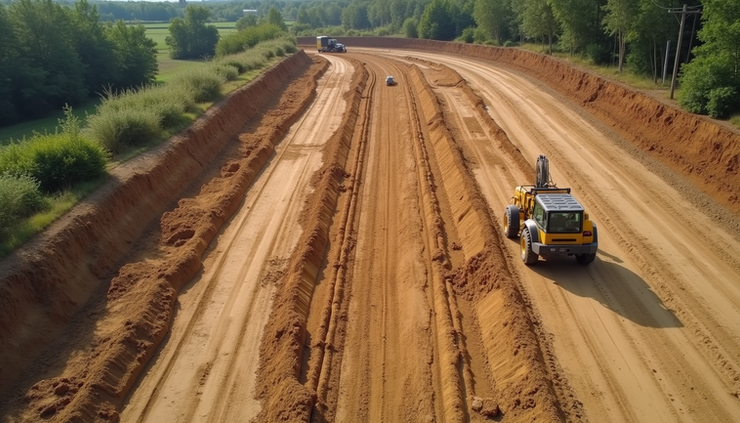
Practical Tips for Managing Soil Types in Earthmoving Projects
Conduct thorough soil testing before excavation to identify soil types and moisture content.
Adjust excavation methods based on soil behavior; for example, use slower digging speeds in clay or rocky soils.
Implement proper drainage systems to manage water in clay and silt soils.
Use appropriate compaction equipment and techniques tailored to the soil type.
Monitor weather conditions closely, as rain can drastically change soil stability, especially in clay and silt.
Train heavy machinery operators on soil-specific challenges to improve safety and efficiency.
By understanding soil types in construction, teams can plan excavation and grading more effectively. This knowledge helps avoid costly mistakes, ensures site safety, and supports long-lasting structures.
Soil behavior is a key factor in earthmoving projects site preparation. Taking the time to assess and adapt to soil conditions leads to smoother excavation planning construction site preparation and better soil compaction results. Next time you start a project, consider the soil beneath your feet, it will shape your entire process.


Comments